


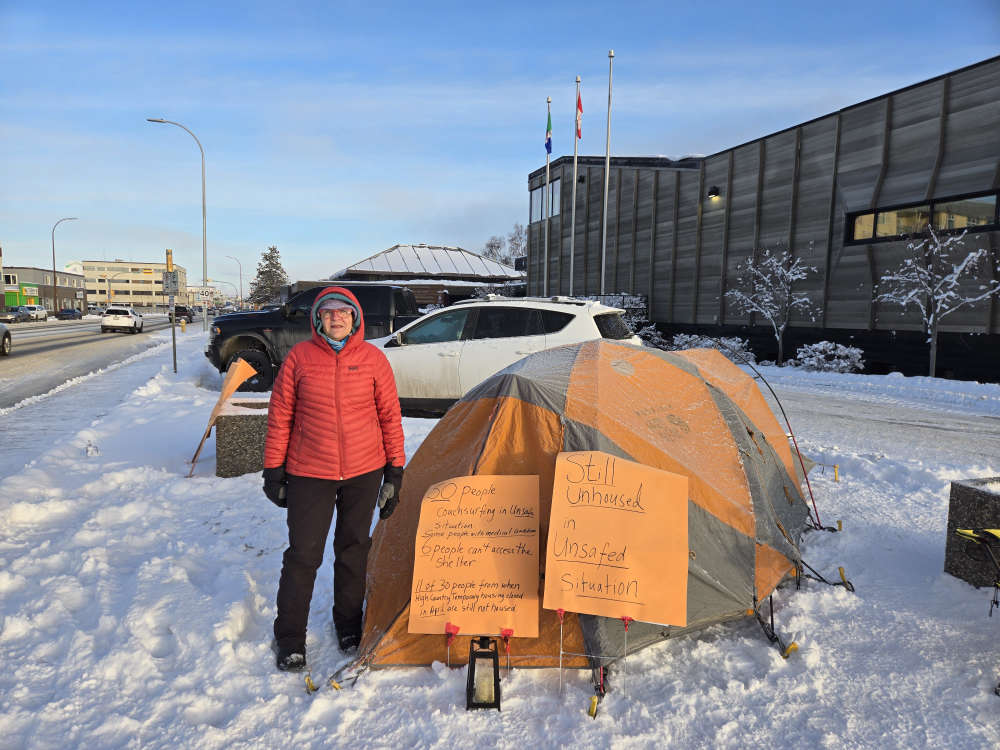
Dozens of people marked Poverty and Homelessness Accountability week with a walk to the Jim Smith building, where the mother of a homeless man spent the night camping in the parking lot.
The Yukon Anti-Poverty Coalition closed Poverty and Homelessness Accountability Week with the Actions for Accountability Rally on Friday.
Dozens of Whitehorse residents met at the Healing Totem pole on Main Street to share their thoughts and concerns before walking together to the Jim Smith Building.
Among the walkers on Friday was Yukon NDP Leader Kate White. She said that governments, including the Government of Yukon, making statements regarding poverty and homelessness is one thing; but holding them accountable is what prompts change.
“We can’t have governments make commitments, or say nice things, without follow-up action,” said White. “What we’ve seen from the Anti-Poverty Coalition and other non-government organizations that fight for dignity and the rights of people, is that, we’re talking now about how there needs to be accountability measures.”
Meeting up with the YAPC supporters at the Jim Smith building was Sylvie Binette, who had spent the night of October 24 in a tent she had pitched in the parking lot in solidarity with her son, who is homeless. Binette says she was lucky to have good equipment and access to her vehicle, but she learned a few things from the experience of camping downtown.
“First of all, there’s lots of noise,” said Binette. “It’s always noisy. You’re very exposed if you want to be in a safe place. There are no public washrooms.”
“I wasn’t cold, because I have a good sleeping bag, but I can just imagine someone who, first of all, has to carry all that gear without a vehicle. How do they do it? Do they let it set up somewhere? Is it safe, where they have it? Because they don’t want to be in plain sight just like where I am.”
“And I got the comfort of having friends this morning and last night who brought me warm drinks, you know? Tea and coffee this morning and breakfast. But that’s not the case for most people who are homeless.”
According to White, Binette broke a law that had been changed following tent cities in Whitehorse back in 2011.
“[The Yukon Party] actually changed legislation to make camping on crown land illegal,” said White. “That’s how they addressed the issue, and I have a huge amount of respect for Sylvie, who’s camping and drawing that attention.”
“People just need to be reminded that it’s not great for everyone right now.”
White said that the suggestions from the accountability forum will take time and collaboration from all levels of government and community.
Last week, Whitehorse participated in a Point in Time count covering 24 hours of homelessness. The results from that count are expected in early 2025.
 Independent review panel publishes first status report in Department of Education review
 ATCO Electric Yukon Gets $7.5M to Fix Billing Issues with Smart Meters
 Yukon NDP calls on Yukon government to investigate electricity billing concerns
 Youth investment fund supports 13 community projects across Yukon
 FNNND challenges Mayo Dam spillway project over treaty and fish passage concerns
 First Nation of Na-Cho Nyäk Dun youth benefit as mining firms fund mayo school sports
 BC man convicted of manslaughter
 Hamilton Boulevard trail cleared as winter pilot project wraps up
 Yukon RCMP roll out new navy-blue uniform shirts
 Yukon releases final flood maps for Dawson, Klondike Valley, Upper Liard
 Inquest into the death of Manui Roux to be held in Whitehorse
 Yukon municipalities to receive record $30 million in funding
 Yukon expands winter electricity relief for residents
 Ross River Dena Council says 'no' to proposed mining on its traditional territory
 LSCFN stands firm: 'No mining in the Breadbasket'
 Yukon Government accepts responsibility for abuse at Jack Hulland Elementary
 Whistle Bend road connector project gets $8.7M boost from federal government
 Yukon Government signs deal with Alliance Health for primary care clinic
 Man Missing in Whitehorse: Reuben van Klaveren Sought by RCMP