


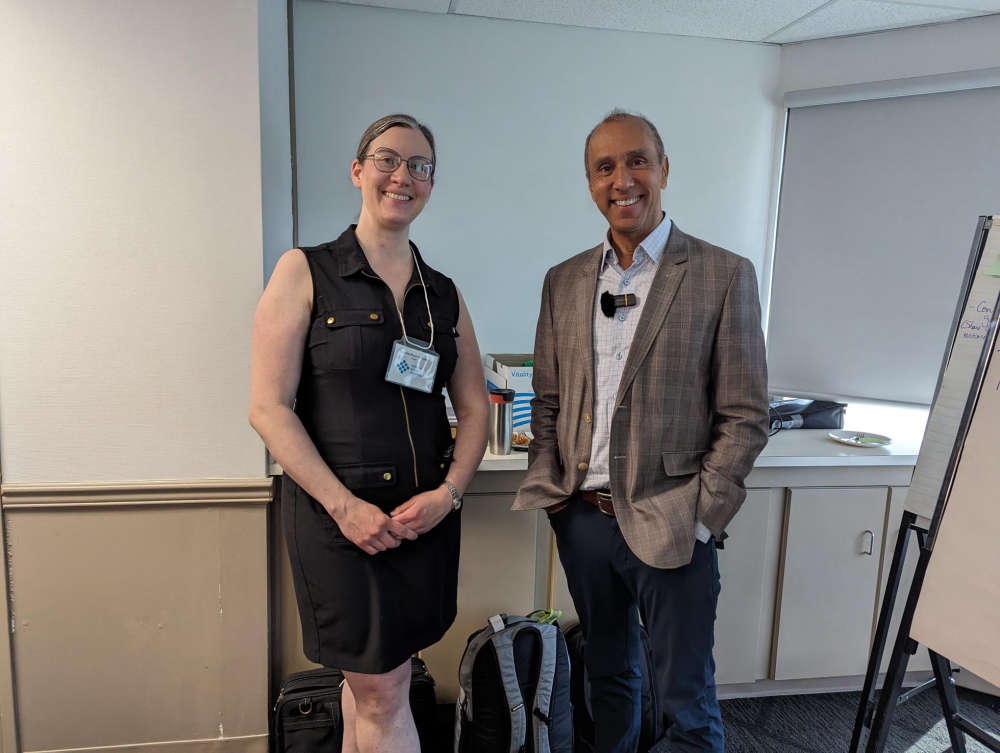
Queens university political scientist and guest speaker admires the process for giving members the "luxury of time."
The Yukon Citizens’ Assembly on Electoral Reform has been hosting public talks to discuss electoral reform in the Yukon.
Electoral reform, according to Queens University political scientist and Yukon Citizen’s Assembly guest speaker Jonathan Rose, is the act of look at the current system for electing officials, and adjusting it to stay up-to-date with modern technology and values, if necessary. Rose says that it’s up to the Yukon Citizen’s Assembly to decide what changes, if any, to make to the system in the Yukon.
“The members of the Yukon Citizens’ Assembly need to think about what it is that the system in the Yukon should be doing, what it does well, and what can be improved upon,” said Rose in an interview with CHON-FM. “And, once they’ve established what the problems are, then we present them with an option of solutions.”
“And, to be clear, it needs to be a ‘made-in-the-Yukon’ solution, so it needs to be responsive to what’s happening here on the ground.”
Yukon Citizens’ Assembly chair Dr. Sara McPhee-Knowles says that making changes in the Yukon isn’t a new idea. Changes to the current system began over 40 years ago.
“Some major shifts that happened in the current system were in the lead-up to responsible government in 1979,” said McPhee-Knowles. “The number of seats expanded to 16 in 1978, which was a big shift, and it was done that way to ensure [that] Indigenous MLAs would be elected.”
“And then, in about 2005, there was a report done on examining some electoral reform options. And the recommendation in that report at that time was not to move forward with changes, given the context at the time.”
The Yukon Citizens’ Assembly consists of 38 members; two from each of the 19 electoral districts. According to McPhee-Knowles, the membership of the assembly is widely diverse in terms of age, gender, Indigenous ancestry, and how long they’ve lived in the Yukon.
McPhee-Knowles says that the diverse perspectives and backgrounds of the assembly don’t stop the assembly from agreeing on core values. But she also clarified that decision-making is still far in the future.
“At this point in time, they’re really still soaking in – one of our members used a wonderful metaphor this weekend – in the knowledge soup, and learning and thinking about that,” said McPhee-Knowles. “There is really good agreement in the group about what values are important, which I think is helpful for how they’re going to move forward, and I think they’ll be able to rely on that as they carry on.”
“But, […] we’re not at the point of making a decision yet. They’re still at the point of really considering these different options.”
According to Jonathan Rose, the Yukon Citizens’ Assembly is handling the learning sessions and meetings very well. He says that allowing the assembly to take its time is crucial to decision-making.
“One of the great things about the process is it gives the luxury of time for citizens,” said Rose. “And how often do we have that? Not very frequently. We’re called on to make decisions throughout the day that are quick and spontaneous without thinking carefully about the consequences of those decisions in any meaningful way.”
“The process here, which allows for four weekends – intense weekends, full days – gives members the luxury of time. The luxury of playing with ideas and thinking about how these might play out in the Yukon. And that’s really a novelty. That’s great!”
The Yukon Citizens’ Assembly on Electoral Reform records its learning sessions and posts them on its website, yukoncitizensassembly.ca. Submissions of thoughts and opinions from the public will also be open through the website until August 12.
The next learning session is scheduled for August 24 and 25.
 Independent review panel publishes first status report in Department of Education review
 ATCO Electric Yukon Gets $7.5M to Fix Billing Issues with Smart Meters
 Yukon NDP calls on Yukon government to investigate electricity billing concerns
 Youth investment fund supports 13 community projects across Yukon
 FNNND challenges Mayo Dam spillway project over treaty and fish passage concerns
 First Nation of Na-Cho Nyäk Dun youth benefit as mining firms fund mayo school sports
 BC man convicted of manslaughter
 Hamilton Boulevard trail cleared as winter pilot project wraps up
 Yukon RCMP roll out new navy-blue uniform shirts
 Yukon releases final flood maps for Dawson, Klondike Valley, Upper Liard
 Inquest into the death of Manui Roux to be held in Whitehorse
 Yukon municipalities to receive record $30 million in funding
 Yukon expands winter electricity relief for residents
 Ross River Dena Council says 'no' to proposed mining on its traditional territory
 LSCFN stands firm: 'No mining in the Breadbasket'
 Yukon Government accepts responsibility for abuse at Jack Hulland Elementary
 Whistle Bend road connector project gets $8.7M boost from federal government
 Yukon Government signs deal with Alliance Health for primary care clinic
 Man Missing in Whitehorse: Reuben van Klaveren Sought by RCMP